Why silicon carbide has become a key high-temperature heating solution.
In industrial furnace technology, the choice of heating elements directly determines the furnace’s performance, operational stability, and maintenance costs. As the temperature range of industrial applications continues to increase, traditional metal heating materials have gradually revealed limitations such as low temperature resistance, severe oxidation, and unstable lifespan. Against this backdrop, silicon carbide heating elements, as a non-metallic high-temperature heating element, have gradually become an important component of modern industrial furnaces.
The core advantage of silicon carbide heating elements lies primarily in their material properties. Silicon carbide is a high-hardness, high-wear-resistant, and high-temperature-resistant ceramic material with excellent thermal stability and oxidation resistance. In high-temperature environments, its physical and chemical properties remain relatively stable, allowing it to operate for extended periods in an air atmosphere without rapid degradation. This characteristic makes it particularly suitable for industrial applications above 1200℃.
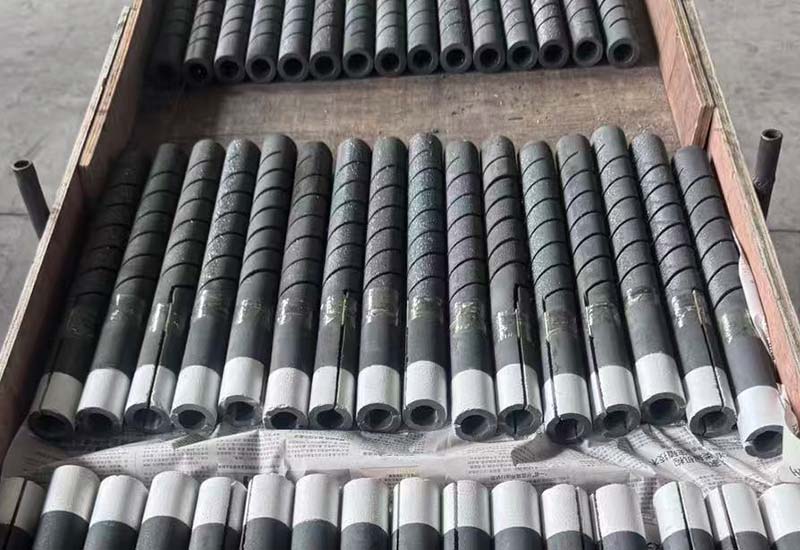
From a structural design perspective, silicon carbide heating elements can be designed in various structural forms to meet the needs of different furnace types and operating conditions, such as equal-diameter type, thickened ends type, spiral groove type, single-ended lead type, and special shapes such as U-shaped and W-shaped. This highly flexible structural design capability allows it to adapt to different spatial layouts, power requirements, and temperature uniformity requirements.
In modern industrial furnace applications, silicon carbide heating elements not only perform the basic function of “heating” but also play a crucial role in temperature control accuracy. Their resistance changes with temperature in a predictable manner, facilitating precise control in conjunction with control systems. This characteristic is particularly critical for processes such as ceramic sintering, electronic material sintering, and glass melting, which require strict temperature profiles.
From an operating cost perspective, although the initial purchase cost of silicon carbide heating elements is usually higher than some metal heating elements, their overall cost advantage is significant. Longer service life, lower maintenance frequency, and more stable operation effectively reduce downtime for repairs and replacement costs. For continuous production enterprises, the value brought by this stability far outweighs the difference in initial purchase price.
In recent years, with the development of high-end manufacturing and new materials industries, the application scope of silicon carbide heating elements has been continuously expanding. For example, in crystal growth furnaces, laboratory-grade high-temperature furnaces, and special material preparation equipment, the requirements for the stability and purity of heating elements are higher. Silicon carbide heating elements, due to their non-metallic properties and low risk of contamination, are gradually becoming the preferred solution.
From an industry perspective, silicon carbide heating elements are not a “one-size-fits-all solution.” Their selection, installation method, and operational management are equally crucial. Unreasonable design, improper current matching, or insufficient cooling at the cold end can all affect their service life. Therefore, modern industrial furnace systems are increasingly emphasizing “integrated heating solutions” rather than the procurement of single components.
Overall, the role of silicon carbide heating elements in modern industrial furnaces has shifted from an “optional component” to a “core technological component.” Understanding their performance characteristics and application logic is an important prerequisite for industrial users to achieve efficient, stable, and high-quality production.