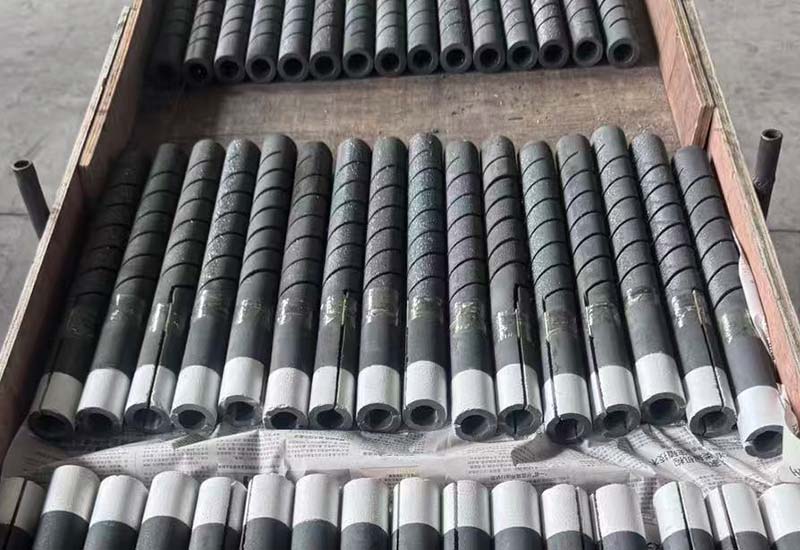
Two straight SiC elements can have the same overall length, hot-zone length, and nominal resistance yet require different furnace openings and terminal arrangements. The difference may be found at the cold ends: one element maintains a uniform diameter, while the other uses enlarged ends.
This distinction is central to silicon carbide heating elements technical data because it affects dimensional drawings, furnace-wall clearance, supporting points, connection hardware, and replacement compatibility. However, enlarged ends do not automatically make one element better, more efficient, or longer-lasting than another. Selection must be based on the complete furnace system.
This guide compares DH equal-diameter and DB thickened-end structures using verified geometric differences. It also explains what industrial buyers should place on a technical data sheet before requesting a quotation or replacing an existing element.
Table of Contents
What Do DH and DB Mean in Silicon Carbide Heating Elements Technical Data?
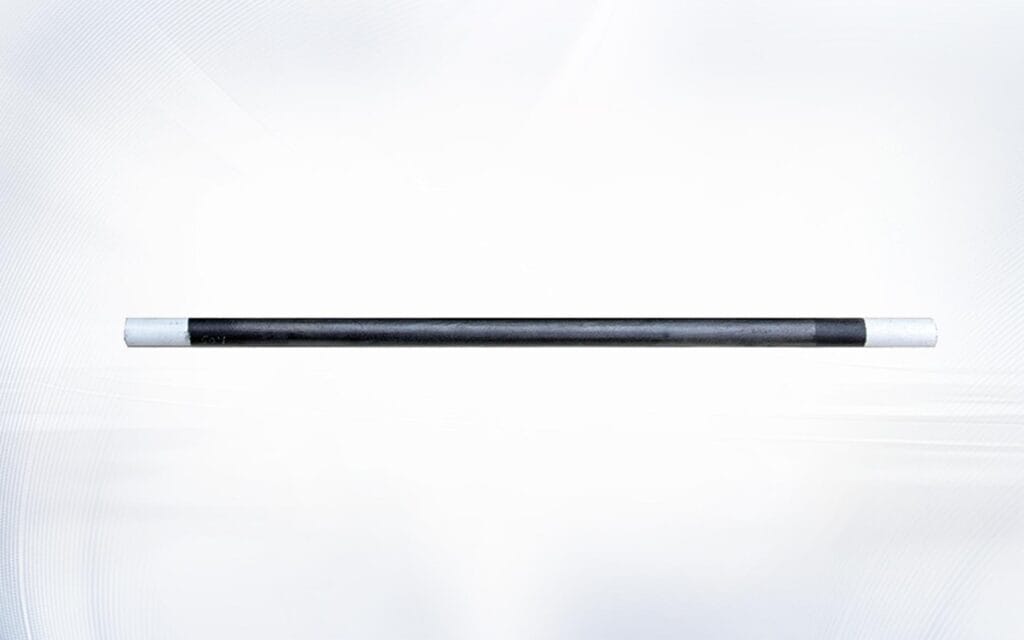
On Qixiang’s current product pages, the verified distinction between the two models is their external geometry.
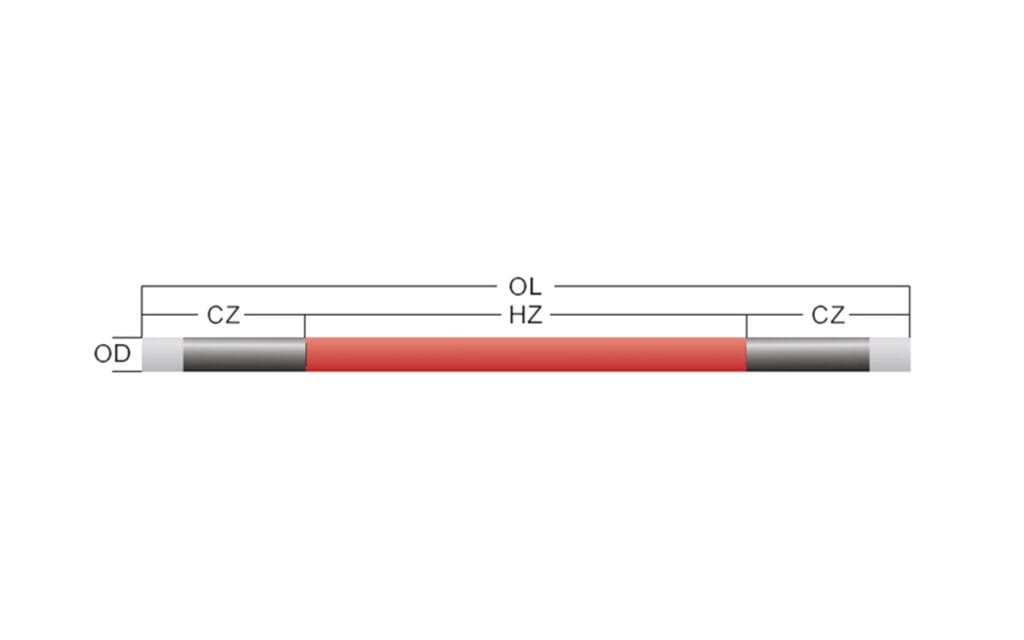
The DH type SiC heating element is described as an equal-diameter straight element. Its hot zone and cold ends have the same nominal outside diameter, shown as OD.
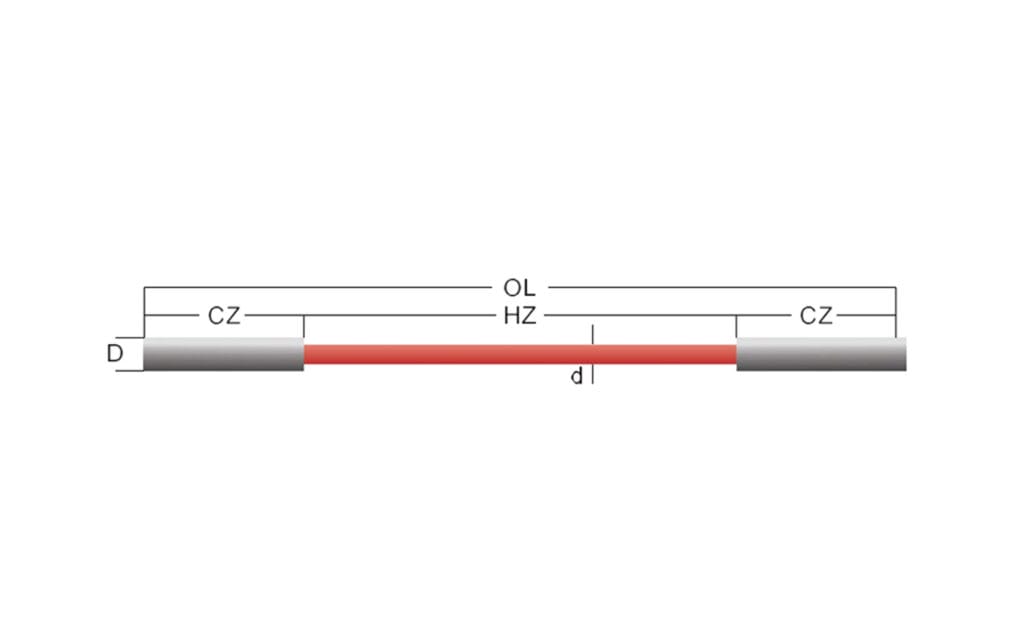
The DB type silicon carbide heating element has a smaller-diameter heating section and enlarged cold ends. Its drawing therefore requires two diameter values:
- d: diameter of the active heating section
- D: diameter of the enlarged cold ends
Both types also require:
- HZ: hot-zone or heating-section length
- CZ: cold-zone or cold-end length
- OL: overall length
- R: specified resistance under an agreed reference condition
These codes should not be treated as universal specifications. A model name may be interpreted differently by different factories or furnace builders. Reliable silicon carbide heating elements technical data must therefore include a drawing, dimensional values, resistance requirements, and furnace operating information.
DH vs DB: The Verified Structural Difference
The following comparison focuses on characteristics that can be established from the visible geometry and dimensional format.
| Comparison Point | DH Equal-Diameter Element | DB Thickened-End Element |
|---|---|---|
| Basic geometry | Straight element with a uniform nominal diameter | Straight element with a smaller hot-zone diameter and larger cold ends |
| Diameter notation | OD | d for the hot zone and D for the cold ends |
| Hot zone | Central active section | Central active section |
| Cold ends | Same external diameter as the hot zone | Larger external diameter than the hot zone |
| Furnace-hole review | Based mainly on OD and required clearance | Based on the larger D value and transition geometry |
| Support compatibility | Supports must match the uniform body diameter | Supports and sleeves must account for enlarged ends |
| Replacement identification | May appear as one continuous straight rod | Often visually recognizable by thicker terminal sections |
| Essential drawing details | OD, HZ, CZ1, CZ2, OL | d, D, HZ, CZ1, CZ2, OL, transition position |
| Electrical confirmation | Resistance and cold-end construction must be specified | Resistance and cold-end construction must still be specified |
| Interchangeability | Not automatically interchangeable with DB | Not automatically interchangeable with DH |
A useful silicon carbide heating elements technical data sheet should separate verified measurements from assumptions. For example, a buyer should not infer joint construction, material grade, resistance tolerance, or maximum surface loading from the letters DH or DB alone.
Why Equal Diameter Does Not Mean Equal Resistance
A common misunderstanding is that an equal-diameter element must generate the same amount of heat along its entire length. That is not how a properly designed straight SiC element works.
The central hot zone is designed to provide most of the useful furnace heat. The cold ends are intended to carry current through or near the furnace wall while limiting unnecessary heating close to the connections.
For a simplified conductor, resistance can be represented as:
R = ρL / A
where:
- R is electrical resistance
- ρ is material resistivity
- L is conductor length
- A is cross-sectional area
A general explanation of this relationship is available in the reference on electrical resistance and conductance.
The formula shows that increasing cross-sectional area can reduce resistance when the material, length, and temperature remain comparable. This helps explain the geometric principle behind an enlarged DB cold end.
However, geometry is not the only variable. Resistivity can also differ because of material composition, density, processing, porosity, and cold-end manufacturing methods. Therefore:
- A DH element can have lower-resistance cold ends even though the external diameter remains uniform.
- A DB element gains additional cross-sectional area at its enlarged ends, but its actual performance still depends on material and manufacturing data.
- The ratio between hot-zone and cold-end resistance cannot be calculated from diameter alone unless the relevant resistivity and construction data are known.
This is why silicon carbide heating elements technical data should include resistance values and manufacturing confirmation rather than relying only on photographs.
How Cold-End Diameter Affects Furnace-Wall Fit
The most immediate practical difference between DH and DB elements is often found at the furnace wall.
Furnace Openings
A DH element passes through an opening sized around its uniform OD. A DB element must pass through an opening that accommodates the larger cold-end diameter D, not only the smaller heating-section diameter d.
If a replacement DB element has the correct hot-zone diameter but a larger cold end than the original furnace opening, it may not fit. Forcing it through the lining can introduce mechanical stress or damage the element.
Sleeves and Supports
Ceramic sleeves, support pads, retaining structures, and terminal covers must be checked against the actual cold-end geometry. A support originally designed for a uniform rod may not accept an enlarged DB end.
Clearance should allow for installation and thermal movement without leaving the element unsupported. The exact value must be confirmed by the furnace designer or element supplier rather than copied from an unrelated installation.
Transition Position
A DB drawing should show where the diameter changes from d to D. If the transition is positioned incorrectly, the enlarged section may interfere with the furnace lining, or part of the active section may enter the wall.
Consequently, complete silicon carbide heating elements technical data should include transition dimensions instead of showing only d, D, and OL.
Is DH or DB Better for a Replacement Project?
Neither structure is universally better. For replacement work, compatibility is more important than choosing the design that appears more advanced.
When a DH Structure May Be the Logical Starting Point
A DH equal-diameter element may be the appropriate starting point when:
- The existing furnace holes and supports were designed for a uniform rod.
- The original element has one consistent outside diameter.
- Available space does not accommodate enlarged cold ends.
- The existing sleeves, supports, and clamps match the DH geometry.
- The approved furnace drawing already specifies an equal-diameter structure.
These conditions do not prove that every DH element with the same dimensions is electrically compatible. Resistance and hot-zone placement must still be checked.
When a DB Structure May Be the Logical Starting Point
A DB thickened-end structure may be the appropriate starting point when:
- The original element clearly has enlarged terminal sections.
- Furnace openings and sleeves were designed around a larger cold-end diameter.
- The existing drawing specifies separate d and D measurements.
- The transition positions match the furnace-wall construction.
- Terminal clamps and conductive strips are sized for the larger ends.
A DB element should not be selected solely because enlarged cold ends appear stronger or cooler. The furnace’s physical and electrical requirements determine whether the structure is suitable.
The silicon carbide heating rod replacement guide provides additional checks for deciding whether to replace one element or an entire furnace zone.
Choosing Between DH and DB for a New Furnace
A new furnace project offers more design flexibility, but the choice still needs engineering coordination.
A complete review should consider:
- Furnace chamber width
- Lining and insulation thickness
- Required hot-zone position
- Element installation direction
- Furnace-hole and sleeve construction
- Terminal enclosure space
- Voltage and available power
- Number of elements per control zone
- Series, parallel, star, or delta connection
- Target surface loading
- Working and maximum furnace temperatures
- Furnace atmosphere and process contamination
- Maintenance access
- Required spare-element strategy
The element cannot be evaluated independently from the heating system. General industrial process-heating resources likewise emphasize system-level evaluation and operating performance.
For new equipment, silicon carbide heating elements technical data should be reviewed by the furnace designer, electrical engineer, element supplier, and maintenance team before the furnace openings and terminal enclosures are finalized.
Dimensions Required on a DH or DB Technical Drawing
A photograph with a ruler beside the element is not a technical drawing. It may help identify the general shape, but it cannot establish accurate manufacturing references.
DH Drawing Fields
A DH drawing should show:
- Uniform outer diameter, OD
- Hot-zone length, HZ
- Cold-end length, CZ1
- Cold-end length, CZ2
- Overall length, OL
- Hot-to-cold transition positions
- Terminal contact length
- Resistance and tolerance
- Straightness or other relevant dimensional tolerance
- Measurement units
When the two cold ends are equal:
OL = HZ + 2(CZ)
When they are unequal:
OL = HZ + CZ1 + CZ2
DB Drawing Fields
A DB drawing should show:
- Heating-section diameter, d
- Cold-end diameter, D
- Hot-zone length, HZ
- Cold-end lengths, CZ1 and CZ2
- Overall length, OL
- Length and shape of each d-to-D transition
- Terminal contact length
- Resistance and tolerance
- Relevant dimensional tolerances
- Measurement units
The same overall-length relationship may apply, but the reference points must be clearly defined. Do not assume that a tapered or transitional area belongs entirely to the hot zone or cold zone without confirmation.
These measurements form the dimensional core of silicon carbide heating elements technical data, but electrical and operating information must be added before production is confirmed.
Resistance and Power Compatibility Still Control the Selection
A DH element and a DB element can physically fit the same furnace but behave differently if their electrical data are incompatible.
For a simplified resistive load:
P = V² / R
and:
P = I²R
These relationships demonstrate why resistance influences current and power. In a real furnace, performance also depends on element temperature, circuit arrangement, controller design, transformer range, connection condition, and resistance variation within the zone.
A replacement request should state:
- Required resistance
- Resistance tolerance
- Reference or test condition
- Furnace voltage
- Total installed power
- Number of elements
- Elements per control zone
- Circuit arrangement
- Existing resistance measurements
- Controller or transformer information
- Whether new elements will operate with aged elements
Do not assume that two elements with matching d, D, HZ, CZ, and OL are interchangeable. The silicon carbide heating element resistance guide explains why resistance matching is necessary when several elements operate together.
Complete silicon carbide heating elements technical data should connect geometry to the furnace circuit rather than presenting dimensions and resistance as unrelated specifications.
Installation and Terminal Differences to Check
Cold-end geometry also affects connection hardware and installation access.
Clamp Fit
A clamp must match the actual terminal diameter. A clamp intended for a DH element may not fit a DB cold end, while an oversized clamp may not provide stable contact pressure on a smaller terminal.
Conductive Strip Contact
The conductive strip should provide suitable contact area, flexibility, and current-carrying capability. It should not pull the element sideways or create stress during thermal movement.
Terminal Enclosure Space
The larger D value of a DB element may affect the spacing between neighboring terminals, clamp clearance, protective covers, and cable routing.
Furnace-Hole Alignment
Straight ceramic elements should not be used to correct misaligned openings. If the holes do not share a proper centerline, forcing the element into position can create bending stress.
Maintenance Safety
Inspection and measurement should only be performed after the furnace has been shut down, isolated, and cooled according to the facility’s procedures. Guidance on the control of hazardous energy is relevant when electrical and thermal equipment is serviced.
The guide to SiC heating element terminals provides further information about clamps, conductive strips, contact resistance, and terminal overheating.
A Practical DH vs DB Decision Table
Use this table as an initial screening tool, not as a final engineering approval.
| Furnace or Replacement Condition | Initial Direction | Additional Check |
| Existing rod has one uniform diameter | Review DH | Confirm cold-end construction and resistance |
| Existing rod has visibly enlarged ends | Review DB | Measure both d and D |
| Furnace hole accepts OD but not a larger cold end | DH may fit more easily | Confirm electrical requirements |
| Existing sleeve was designed around diameter D | Review DB | Check transition position and support |
| Only overall length is known | Do not select yet | Measure HZ, CZ, diameter, and resistance |
| Original element is broken into several pieces | Reconstruct from furnace and neighboring rods | Verify against electrical drawings |
| New furnace has not been drilled | Either structure may be reviewed | Coordinate openings, supports, power, and maintenance |
| One element will operate with aged rods | Geometry alone is insufficient | Measure and match zone resistance |
| Terminal overheating has occurred repeatedly | Do not change model blindly | Inspect contacts, cold ends, holes, and circuit load |
The decision should be recorded in the project’s silicon carbide heating elements technical data file so that purchasing, engineering, and maintenance teams use the same approved information.
Common Mistakes When Comparing DH and DB Elements
Treating “Equal Diameter” as “Equal Temperature”
The same external diameter does not mean every section has the same resistivity or heat generation. The hot zone and cold ends are designed for different functions.
Recording Only One DB Diameter
Writing only “OD” for a DB element leaves the supplier unable to distinguish the hot-zone diameter from the enlarged cold-end diameter.
Selecting DB Because It Looks More Durable
A thicker terminal section does not automatically prove longer service life. Furnace atmosphere, loading, surface temperature, resistance, cycling, terminal contact, and installation stress also affect performance.
Converting DH to DB Without Reviewing Furnace Holes
Even when HZ and OL remain unchanged, the DB cold end may not pass through the existing sleeve or support.
Converting DB to DH From the Hot-Zone Diameter Alone
A uniform replacement based only on d may be too small for the existing supports and clamps. Its electrical design may also differ from the original element.
Ignoring Transition Dimensions
The point where d changes to D can determine whether the element sits correctly in the furnace wall.
Mixing Model Codes From Different Sources
DH, DB, ED, dumbbell, and other terms may not be applied consistently across all suppliers. Drawings and measured values are more reliable than names alone.
Assuming the Published Maximum Temperature Is the Operating Target
Maximum element temperature, maximum furnace temperature, and recommended continuous operating temperature are not necessarily the same value. Confirm the conditions for the specific element, atmosphere, loading, and operating cycle.
Avoiding these errors makes silicon carbide heating elements technical data more useful for actual procurement instead of turning it into a list of incomplete product labels.
RFQ Checklist for DH and DB Silicon Carbide Elements
The following information should accompany a quotation request.
| RFQ Category | Information Required |
| Element structure | DH equal diameter, DB thickened end, or structure to be confirmed |
| Diameter | DH: OD; DB: d and D |
| Lengths | HZ, CZ1, CZ2, and OL |
| DB transition | Transition location, length, and profile |
| Resistance | Required value, tolerance, and reference condition |
| Electrical system | Voltage, current, power, controller, and circuit arrangement |
| Furnace details | Furnace type, chamber size, wall thickness, and hole diameter |
| Operating conditions | Working temperature, maximum temperature, atmosphere, and cycle |
| Installation | Horizontal or vertical, supports, sleeves, and terminal clearance |
| Accessories | Clamp type, conductive strip dimensions, and connection direction |
| Existing elements | Photos, drawings, resistance readings, and installation history |
| Zone information | Number of elements per zone and age of remaining elements |
| Order information | Required quantity and planned spare quantity |
| Failure details | Breakage, slow heating, terminal overheating, or resistance imbalance |
For replacement projects, send front, side, terminal, and installed-position photographs. Mark all measurement reference points directly on the drawing.
This RFQ format turns silicon carbide heating elements technical data into an actionable specification and reduces back-and-forth communication before production.
Incoming Inspection Before Furnace Installation
Delivered elements should be checked against the approved drawing before the planned furnace shutdown.
Inspect:
- Model and geometry
- OD or d/D values
- HZ, CZ1, CZ2, and OL
- Transition positions on DB elements
- Resistance values and grouping labels
- Terminal contact areas
- Straightness and visible cracks
- Clamp and strip compatibility
- Quantity and zone identification
- Packaging condition
Record actual measurements instead of marking the items as “checked” without values. If several elements will operate in one electrical zone, retain their resistance and grouping records.
The approved silicon carbide heating elements technical data sheet should remain available to purchasing, maintenance, and incoming quality inspection. This prevents a visually similar but incompatible element from reaching the furnace.
FAQ
What is the main difference between DH and DB silicon carbide heating elements?
A DH element has a uniform nominal outside diameter across the heating and cold sections. A DB element has a smaller heating-section diameter, d, and larger cold-end diameter, D. Resistance, materials, and manufacturing details still require separate confirmation.
Are DB heating elements always better than DH elements?
No. DB elements are not universally better. The correct choice depends on furnace openings, supports, terminal hardware, resistance, circuit design, hot-zone position, and the original furnace specification.
Can a DH element directly replace a DB element?
Not from dimensions such as HZ and OL alone. The furnace holes, sleeves, support diameter, clamps, resistance, and cold-end requirements must all be reviewed before changing structures.
Can a DB element replace an equal-diameter rod?
Only after confirming that the larger cold ends can pass through the furnace openings and fit the supports, terminal spacing, and connection accessories. Electrical compatibility must also be verified.
Why does a DB technical drawing need both d and D?
The heating section and cold ends have different diameters. Using a single diameter would leave the furnace builder unable to size the wall openings, supports, and terminal hardware correctly.
Does a DH element generate heat along its cold ends?
The cold ends are designed to generate less heat than the active zone. A uniform external diameter does not mean the electrical resistivity is uniform throughout the element.
Is overall length enough for ordering a replacement?
No. A complete order requires hot-zone length, cold-end lengths, diameter or d/D, transition dimensions, resistance, terminal data, and furnace operating conditions.
What if the original element has no visible model number?
Measure the existing element and furnace openings, inspect neighboring rods, review old drawings and purchase records, and document the electrical system. Do not assign a DH or DB code from appearance alone.
What information should I send for technical confirmation?
Send a dimensioned drawing, installed photographs, furnace type, wall thickness, working temperature, atmosphere, voltage, power, circuit arrangement, resistance, quantity per zone, connection details, and the observed replacement problem.
Where can I request a DH or DB element review?
Send the completed silicon carbide heating elements technical data, furnace information, drawings, and photographs through the Qixiang contact page. Final dimensions and electrical parameters should be confirmed before production.
Conclusion
The meaningful difference between DH and DB elements is not simply that one rod is uniform and the other looks thicker at the ends. That geometry changes the information required for furnace openings, supports, transitions, clamps, terminal spacing, and replacement inspection.
A DH specification should clearly define OD, HZ, CZ, OL, resistance, and terminal details. A DB specification must add separate d and D measurements plus the position and shape of each diameter transition. Neither structure should be selected from a product name, photograph, or overall length alone.
Reliable silicon carbide heating elements technical data combines geometry with resistance, circuit design, furnace-wall construction, atmosphere, operating temperature, installation method, and connection hardware. When these factors are reviewed together, buyers can distinguish an element that merely resembles the original from one that is properly specified for the furnace.